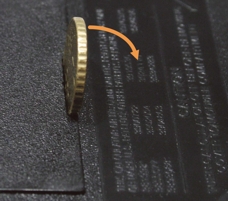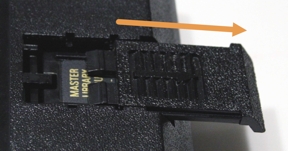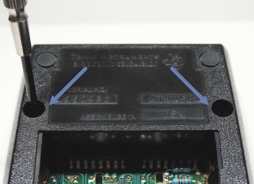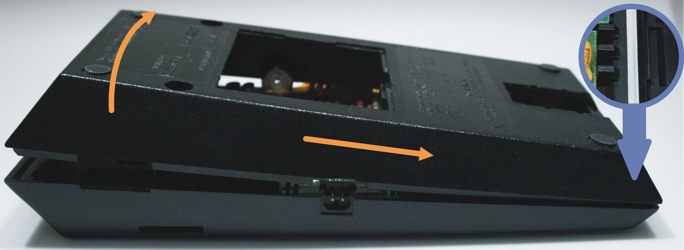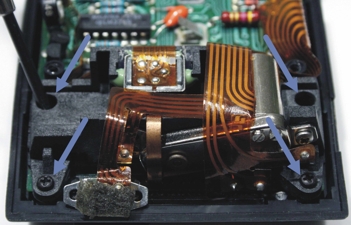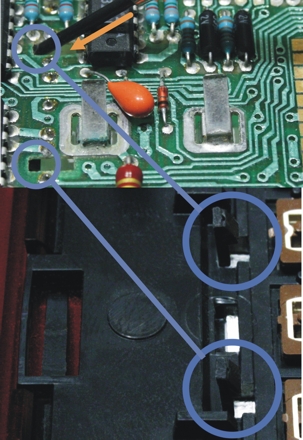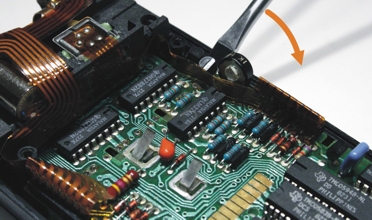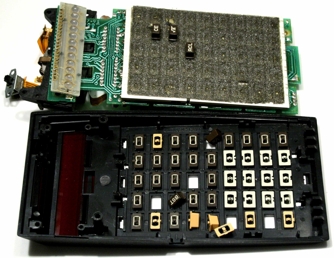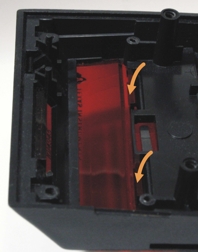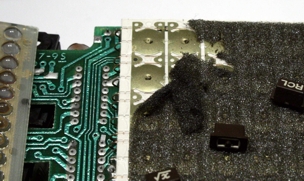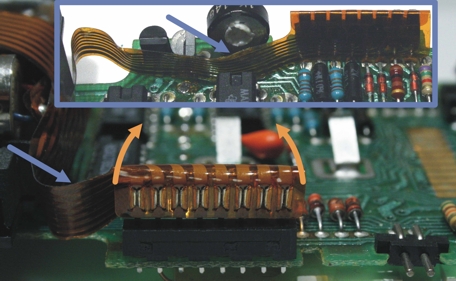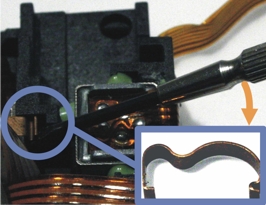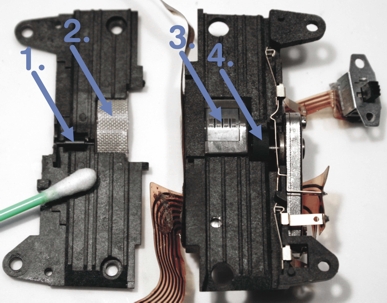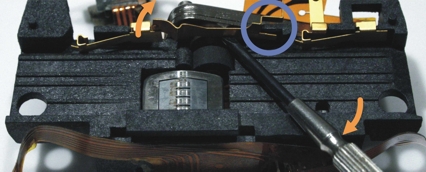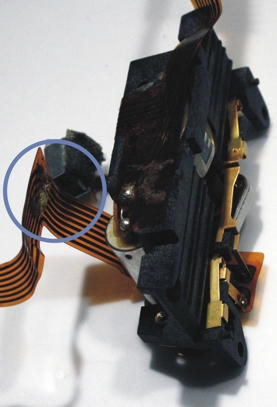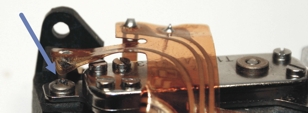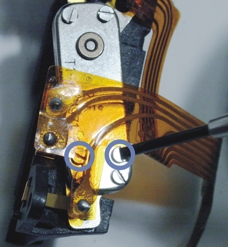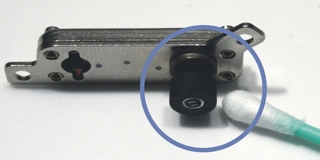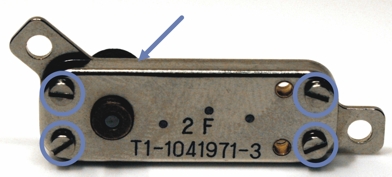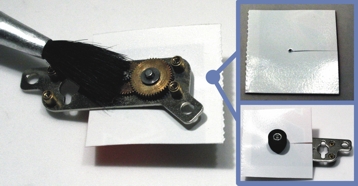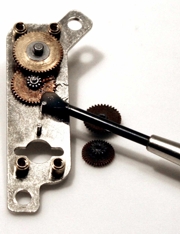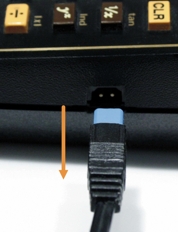
ÿþ <html> <body> <body background="tlo-tm.bmp"> <b><big><big><font color="#112255">HOW TO DISASSEMBLE AND CLEAN YOUR TI-59?</font></big></big></b> <br> <br> <b><font color="#224488">I. SOME INITIAL REMARKS.</font></b> <br> <br> This is version 1.0 of this article. <p> Most common troubles with TI 59 calculators are caused probably by their magnetic card readers; this article should help you solve these problems. Below, I've only included repairs that do not require breaking into electronics (without soldering, to be precise). The card readers of the TI 59 s are, to be sure, very solid and reliable, but with time they wear away or simply get dirty. Since the other elements (electronics, keyboard) could go out of order as well, therefore not any card reading problem stands for the card reader damage. Thus, before you disassemble the calculator (it s always a little bit risky!)  I suggest to try the following: <ol> <li>Control the voltage of Battery Pack (it should be ca. 3,6V),</li> <li>Try to work with AC adaptor/charger (AC9900/H, A9900/Ht, 220V/6,2V 200mA) <b>AND</b> battery pack together,</li> <li>Use Cleaning Cards,</li> <li>Put some alcohol or magnetic head cleaning liquid on the Cleaning Card. They are saturated with cleaning solution, but with time they could be just dried.</li> <li>Try to use other (surely good written) magnetic card.</li> </ol> If the above doesn t help  your card reader is probably really damaged (or, at least, dirty) and you have to repair, or clean it. It s a good opportunity to clean the whole machine thoroughly. If you are afraid, that your experience in electronics and mechanics is not sufficient  I suggest to charge whichever  wizard for this task. Keep always in mind, that: <p> <b><font color="#881111">!! THERE ARE NO SPARE PARTS FOR THESE OLD CALCULATORS !!</font></b> <p> It means  if something goes wrong  you can get the spare parts only from another machine. Repairing the damaged parts is mostly either very hard, or impossible at all. <p> This article was written only for informational purpose. The author takes no responsibility for any consequences of using this information, especially if someone damages his calculator or himself. <p> You can download, copy, share with friends and print out this article but: <ul> <li>You can t use this materials for any commercial purpose, or for any public display (commercial or noncommercial),</li> <li>Modify the materials,</li> <li>Remove any copyright, or other proprietary notations from this materials.</li> </ul> Thanks to MichaB Wronko for helping to prepare of this article. <p> <b><i><big><font color="#112244">And now& to the subject.</font></big></i></b> <p> <hr> <!====================================================================================> <b><font color="#224488">II. WHAT DO YOU NEED?</font></b> <p> <ol> <li>Flat screwdriver, or small coin,</li> <li>Precision Philips screwdriver,</li> <li>Precision flat screwdriver (max. 2 mm broad),</li> <li>Sharp knife,</li> <li>Precision pliers,</li> <li>Several cotton swabs for cleaning,</li> <li>Soft rags or paper for cleaning,</li> <li>A small brush for cleaning,</li> <li>A piece of plastic foil,</li> <li>A 68 x 95 mm piece of ca. 2 mm thick sponge (optionally for exchange).</li> <li>Alcohol and/or magnetic head cleaning fluid,</li> <li>White spirit (only for gear cleaning!),</li> <li>Paraffin jelly or similar light lubricant,</li> <li>Common dental cream for polishing of display filter,</li> <li>Common dish detergent,</li> <li>A small box for the small parts.</li> <li>Enough of time, patience, skills and maybe a big hammer (in case of last despair).</li> </ol> On all the photos below  the points of interest are marked in <b><font color="#224488">blue</font></b>; the things to move (press) are marked in <b><font color="#EE8822">orange</font></b>. <hr> <!====================================================================================> <b><font color="#224488">III. REMOVING OF THE BATTERY PACK (BP1A).</font></b> <p> Firstly  disconnect the AC adapter/charger. The electronics of your TI 59 could be irreversibly damaged when working with AC adapter/charger without battery pack inside! <p> <img src="01-adaptor.jpg" width="178" height="232"><br> <p> Then lever the battery pack with a small coin (or flat screwdriver) and take it out. If you suspect, that the battery compartment got dirty (Ni Cd rechargeable batteries are corroded, or even flowed out)  remove the Library Module first, then open the case and try to remove the battery pack. Be careful  the cells and flowed out chemicals are <b><font color="#882222">toxic!</font></b> Follow your local rules of disposal. <p> <img src="02-coin.jpg" width="228" height="201"><br> <p> <hr> <!====================================================================================> <b><font color="#224488">IV. REMOVING OF THE LIBRARY MODULE.</font></b> <p> Pull the module cover out. The module itself should drop out free; it s fixed only with cover and contact springs. <p> <img src="03-module.jpg" width="288" height="151"><br> <p> <hr> <!====================================================================================> <b><font color="#224488">V. OPENING OF THE CASE.</font></b> <p> Using Philips screwdriver turn these two screws out. <p> <img src="04-main-screws.jpg" width="254" height="184"><br> <p> Raise the case up and simultaneously shift aside, as the arrows show. There are two plastic catches inside  don t break them. <p> <img src="05-case.jpg" width="684" height="250"><br> <p> <hr> <!====================================================================================> <b><font color="#224488">VI. REMOVING OF THE MAIN BOARD.</font></b> <p> Using Philips screwdriver turn out the four screws holding the main board and drive. <p> <img src="06-drive-screws.jpg" width="351" height="225"><br> <p> Push the both plastic catches of main board as shown. Do it very gently  they are really easy to damage (break). Note, that the catches don t hold the main board immediately, but the keyboard module underneath. <p> <img src="07-mainboard-catches.jpg" width="303" height="440"><br> <p> Lever the main board with drive (from both sides) with a flat screwdriver and pull them up. <p> <img src="08-mainboard-lever.jpg" width=372" height="220"><br> <p> <hr> <!====================================================================================> <b><font color="#224488">VII. CASE, KEYBOARD AND DISPLAY FILTER CLEANING.</font></b> <p> Probably after removing the main board it will be somewhat messy (therefore it s really not bad idea to notice the keyboard layout in time; anyway  don t worry!  <a href="http://www.datamath.org/"><font color = "#003366"><b>www.datamath.org/</b></font></a> and <a href="http://www.rskey.org/detail.asp?manufacturer=Texas+Instruments&model=TI-59"><font color = "#003366"><b>wwww.rskey.org/</b></font></a> are always helpful for you). <p> <img src="09-mess.jpg" width="334" height="258"><br> <p> Remove the red display filter pressing both plastic catches with your thumbs as the arrows show. <p> <img src="10-display-window.jpg" width="198" height="252"><br> <p> Now you can clean the case, keys and display filter with some common dish detergent. Additionally you could polish the filter with common dental crème. Don t polish the gold letters (if they survived up to now)  they will rubbed out! <br> Try any cleaning liquid first on an invisible place  some stronger detergents could be pretty aggressive! <p> <hr> <!====================================================================================> <b><font color="#224488">VIII. SPONGE EXCHANGING.</font></b> <p> Sponge is not fixed (glued) to the keyboard module  it should remove freely. Probably it s very old and will tear. It s no problem  clean gently the module form the rests of an old sponge and simply lay a new piece on it. Don t glue the sponge to keyboard module. <p> <img src="11-sponge.jpg" width="304" height="181"><br> <p> <hr> <!====================================================================================> <b><font color="#224488">IX. RIBBON CABLES UNPLUGGING.</font></b> <p> There are two ribbon cables to disconnect. Pull up the connector (best of all  in very small steps, both sides alternately). Notice the correct layout of the bands (blue arrows). <p> <img src="12-ribbon-band-connectors.jpg" width="456" height="281"><br> <p> <hr> <!====================================================================================> <b><font color="#224488">X. DISASSEMBLING OF THE DRIVE.</font></b> <p> After disconnecting the bands  you can take out and disassemble the drive. Lever the holding spring (as shown)  it should jump out (probably you need a precision pliers or tweezers to set it back). There is NO other way to open the drive. If you try something other  you will harm it probably irreversibly. <p> <img src="13-drive-spring.jpg" width="266" height="205"><br> <p> <hr> <!====================================================================================> <b><font color="#224488">XI. CLEANING OF THE DRIVE.</font></b> <p> There are four things to clean with alcohol or magnetic head cleaning fluid. <ol> <li>Pinch roll.</li> <li>Magnetic head clamp,</li> <li>Magnetic head front,</li> <li>Capstan (probably you can clean it better after dismounting the gear).</li> </ol> <p> <img src="14-drive-cleaning.jpg" width="387" height="303"><br> <p> <hr> <!====================================================================================> <b><font color="#224488">XII. REMOVING OF THE GEAR.</font></b> <p> Firstly lever the card sensor switch. It holds at the point marked with blue circle. You don t need to remove it entirely  it s enough to make some room to pull the capstan out. It s reasonable to try to lever this spring in several points. <p> <img src="15-tape-switch.jpg" width="426" height="172"><br> <p> Now detach the ribbon cable as shown (fortunately the glue doesn t hold too strong). <p> <img src="16-band-glue.jpg" width="277" height="407"><br> <p> Pull very carefully the ribbon cable up and turn out the main screw holding the gear. <p> <img src="17-gear-main-screw.jpg" width="308" height="113"><br> <p> Turn out the two (and only!) screws holding the motor (marked with blue circles). Now you can take the gear out. <p> <img src="18-motor-screws.jpg" width="228" height="247"><br> <p> <hr> <!====================================================================================> <b><font color="#224488">XIII. CLEANING OF THE CAPSTAN.</font></b> <p> Having the gear out of drive  you can thoroughly clean the capstan with alcohol or magnetic head cleaning fluid. It s essential for correct transport of magnetic cards. <p> <img src="19-capstan-cleaning.jpg" width="320" height="160"><br> <p> <hr> <!====================================================================================> <b><font color="#224488">XIV. DISASSEMBLING OF THE GEAR.</font></b> <p> Turn out the four screws and lever a gear cover. If it doesn t go with your fingers  use the sharp knife (notice the blue arrow) to lever it. <p> <img src="20-gear.jpg" width="392" height="177"><br> <p> <hr> <!====================================================================================> <b><font color="#224488">XV. CLEANING AND GREASING OF THE GEAR.</font></b> <p> Now you can clean the cogwheels. Do it, best of all, with white spirit and small brush. It s a good idea to prepare a small piece of plastic foil (cut as shown) and fix on the capstan shaft, to prevent the capstan from grease. <p> <img src="21-gear-cleaning.jpg" width="358" height="186"><br> <p> You can put a small drop of lubricant on the capstan s shaft and some paraffin jelly (or similar grease) on the cogwheels and their shafts. I would suggest to use a sour free medical Vaseline for this purpose. Theoretically it s possible to take out the last two cogwheels, but it s very risky, and in fact unnecessary. They can be as well cleaned and greased on their places. <p> <img src="22-gear-greasing.jpg" width="180" height="234"><br> <p> <p> <b><i><big><font color="#112244">That's all...</font></big></i></b> <p> If you ll find mistakes, errors or lacks  simply email me: <a href="mailto:marekczeszek@t-online.de">here</a>  I ll be grateful for any critical advices. <hr> <hr> <b><big><big><font color="#112255">== THE END. ==</font></big></big></b> <br> <hr> <hr> </body> </html>